Most businesses are still asking the wrong question about AI.
They're asking: "Which AI tool should we be using?" And the conversation stays there, tools, subscriptions, prompts, chatbots. Which one is better, which one is cheaper, which one does more.
But that framing is already out of date. And the businesses that stay stuck in it will find themselves significantly behind the ones that have moved on to the real question: how do we make AI a genuine member of our team?
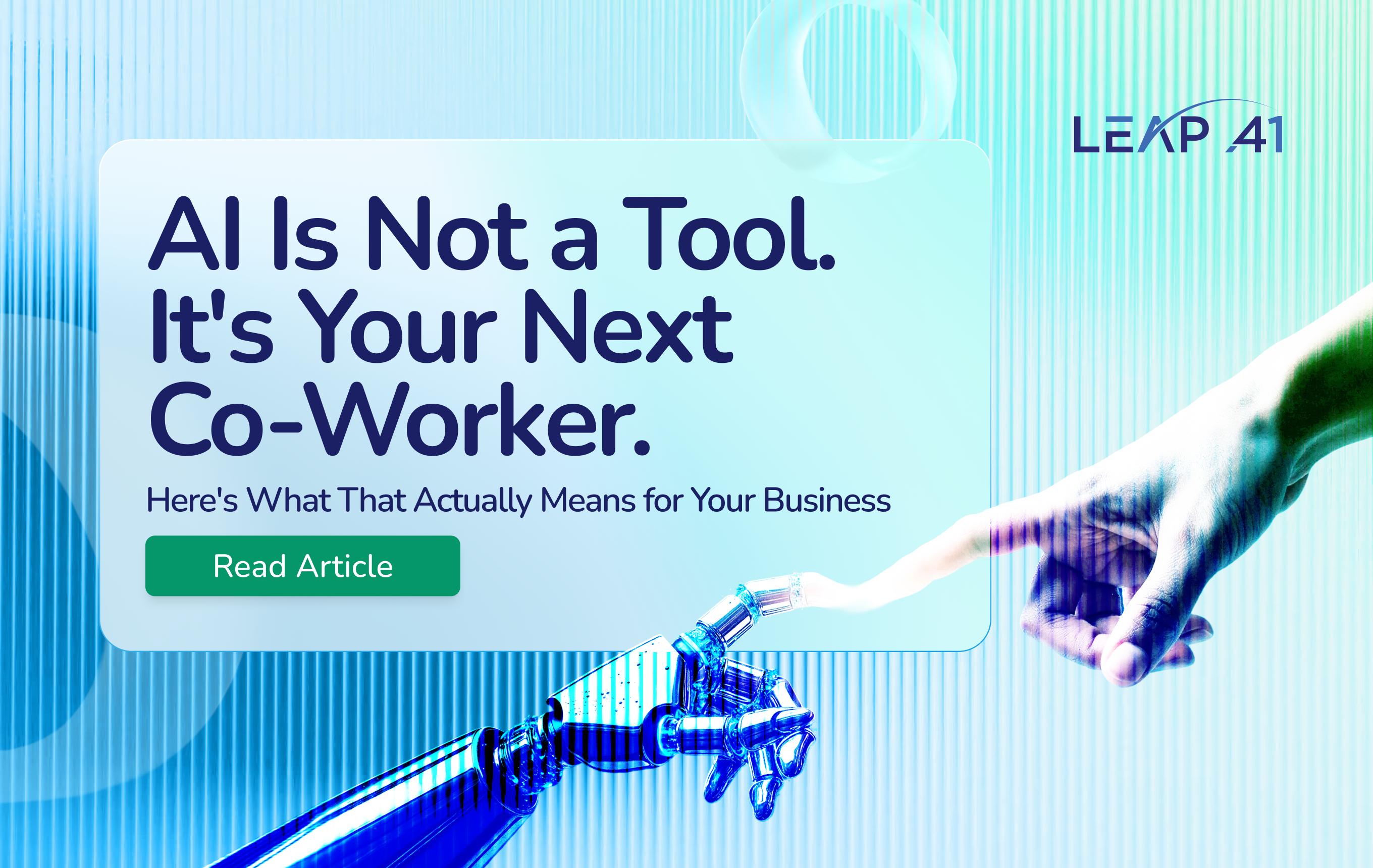
Because that's where this is going. Not AI as a tool you pick up and put down. AI as a co-worker, one that shows up every day, does real work, and collaborates with your people inside a shared environment. The businesses that understand this shift now, and build for it, are the ones that will lead their markets. The ones that don't will spend the next few years wondering why the gap keeps widening.
The Tool Framing Is Holding You Back
Think about what it means to use AI as a tool right now.
You open a chat window. You type something in. You get something back. You read it, judge it, copy what you need, paste it somewhere else, and move on to the next task. The AI helped. But you did everything else, the sequencing, the judgment, the connecting of dots between systems, the follow-through.
That's a calculator, not a co-worker. Useful, yes. Transformative? Not even close.
A toolbox is one step better. You have several AI tools, each doing something specific, one for writing, one for research, one for data. You're more capable. But you're still the one running between them, managing the handoffs, holding the whole thing together in your head.
Here's what neither of those models gives you: a working partner that sees what you see, knows what you know, handles what it can handle, and brings you what needs your judgment, without you having to manage every single step in between.
That's the co-worker model. And it's not theoretical. It's what we're building toward right now.
Bottom line: Thinking of AI as a tool or toolbox means you remain the interface between everything. The co-worker model removes that burden and gives AI a real role in how work actually gets done.
What a Co-Worker Actually Needs
When you hire a new employee, you don't hand them a list of software passwords and wish them luck. You give them a workspace. A place where the work happens, where they can see what others are doing, where communication flows, where tasks are tracked and outputs are visible.
Your AI co-worker needs the same thing. And right now, most businesses haven't built it.
Here's the problem most organizations are sitting inside without realizing it. Your work is scattered. Email is in one place. Your CRM is in another. Your operations platform is somewhere else. Your drive, your project tracker, your finance tools, each in their own silo. As a human, you navigate this constantly. You know where to look. You've built the mental map over years.
But if you want an AI agent to work alongside you, really work, not just answer questions in a chat window, it needs to be able to see the work too. And right now, the work is invisible to it, spread across six platforms it can technically access but has no unified view of.
That's the gap. And it's why so many AI implementations feel like they're almost working but never quite getting there
Bottom line: An AI co-worker without a proper workspace is like a new hire with no desk, no access, and no idea where anything is. You wouldn't expect great work from that person. You can't expect it from AI either.
The Supra-Platform: Building the Space Where Humans and AI Co-Work
This is the concept we keep coming back to at Leap 41, because it's the architectural piece most businesses are missing: the supra-platform.
A supra-platform is not another software tool. It's a layer built above all the platforms your business already runs on, your email, your CRM, your ERP, your drive, your communication tools, whatever your stack looks like. It's the place where work actually happens, where everything connects, and where both your human team and your AI agents operate together in one shared environment.
Think of it this way. Right now, your team members move between platforms all day. They check email, update the CRM, pull a report, send a message, log into the operations system. Each platform holds a piece of the picture. No one platform holds all of it.
The supra-platform changes that. It pulls the relevant context from every platform underneath it into one place. Your AI agent lives there too. It can see what's happening across the business. It can surface the right information at the right moment, take action where it's been given authority to act, flag what needs a human decision, and make the handoff cleanly, without you having to go hunting across six different tabs to figure out what's going on.
And critically: you can see what it's doing. That visibility is not optional. It's the foundation of trust.
Bottom line: The supra-platform is the missing piece in most AI strategies. It's the environment that makes genuine human-AI collaboration possible, not by replacing your existing tools, but by connecting them into one place where both humans and AI can work together.
Why Visibility Is Everything Right Now
Here's something that doesn't get said enough about AI in business: right now, we are in a trust-building phase. And trust requires visibility.
With a human employee, you can see the work. You can walk over, ask a question, review an output, notice when something is off. If someone is struggling or making mistakes, it surfaces. You catch it. You correct it. You build confidence in that person over time, and you give them more responsibility as they earn it.
With AI agents running in the background, doing research, processing data, routing decisions, drafting communications, the work is often invisible. You can't see it happening. You assume it's running correctly. And when something goes wrong, you may not find out until it's already caused a problem, maybe with a client, maybe in an operation that was supposed to be reliable.
This is why the co-working environment matters so much. When your AI agent is operating inside a shared platform that your team can see, the work is no longer invisible. You can monitor it, review it, course-correct it. You can give it more autonomy in areas where it has proven itself, and keep humans closely in the loop in areas where the stakes are higher or the trust isn't fully established yet.
Think about how you'd onboard a new employee. You wouldn't give them full decision-making authority on day one. You'd start them on lower-stakes work, review their outputs, build confidence, and gradually expand their responsibilities as they demonstrate they can handle it. That's exactly the right model for AI agents, and the supra-platform is what makes it possible to manage that process in a real, visible, ongoing way.
Bottom line: Visibility is not a nice-to-have. It's how you build the trust that makes human-AI collaboration actually work, and how you catch problems before they become costly ones.
What This Looks Like in Practice
The shift from "AI as tool" to "AI as co-worker" doesn't happen overnight, and it doesn't require throwing out everything your business already runs on. It's a progression.
It starts with understanding where the work actually lives and how it actually flows, across departments, platforms, and people. Before anything gets automated or handed to an agent, you need that map.
From there, you build the co-working environment: the supra-platform layer that connects your existing tools and gives both your team and your AI agents a shared space to operate in.
Then you introduce AI agents deliberately, starting with work that is well-defined, lower-risk, and measurable. You keep humans doing the same work in parallel at first, using their outputs as the quality benchmark, and measuring the gap between what the human produces and what the AI produces. You shrink that gap over time. You build trust. You give the AI more responsibility as it earns it, exactly the way you would with a new team member.
A practical starting point: ask your team what work they wish they never had to do again. What's the task that gets avoided, delayed, or dreaded? Start there. Removing genuine pain from people's days creates real buy-in fast, and gives you a safe, low-stakes environment to start building that human-AI working relationship.
As that relationship matures, the co-working environment becomes the foundation for something bigger: not just doing the same work faster, but starting to ask what work you can now offer your clients that you couldn't before. That's where the real competitive advantage opens up.
Bottom line: The path from AI tool to AI co-worker is a deliberate progression, one that starts with a shared workspace, builds trust through visibility and measurement, and opens up genuine innovation once the foundation is solid.
The Mindset Shift That Changes Everything
Here's the reframe that matters most.
When you think of AI as a tool, you're always asking: "What can this do for me right now?" It's transactional. You get what you ask for, nothing more.
When you think of AI as a co-worker, you start asking: "How do we work together? What does it need from me to do its job well? What do I need from it? How do we build a working relationship where we're both getting better over time?"
That second set of questions leads somewhere completely different. It leads to an organization that is actually learning, adapting, and improving, not just one that has access to AI, but one that has built AI into the way it operates.
Working with AI today is a lot like raising and developing a new team member. You guide it. You correct it. You give it guardrails. You build its capabilities through consistent feedback and measurement. It's not a one-time setup. It's an ongoing relationship. And just like with people, the effort you put into that relationship is what determines the quality of what you get back.
The businesses that understand this now, and start building accordingly, will find themselves with an organizational capability that compounds over time. The ones still treating AI as a subscription tool will find themselves starting from scratch when the real shift arrives.
Bottom line: The difference between "we have AI" and "AI is a competitive advantage for us" is not which tool you picked. It's whether you built the co-working environment, the trust, and the culture to actually collaborate with it.
Why Now
We are still early in this transition. Most businesses are in the chat-window phase of AI, useful, but nowhere near the real potential. The window to build a genuine co-working infrastructure before your competitors do is open right now.
It won't stay open indefinitely. AI capabilities are doubling every three to four months and accelerating. The businesses that have built the right environment will absorb each new wave of capability smoothly, because the infrastructure is already there. The ones that haven't will face a steeper and steeper climb each time the technology moves forward.
This is the moment to stop asking "which AI tool should we use?" and start asking "how do we build the environment where AI and our people do their best work together?"
That's the question we help businesses answer.
Ready to explore what a co-working environment for AI could look like inside your business? Download our free 7 Pillars report at insights.leap41.ca